Tires Expire!? – They Do Indeed!

You shouldn’t feel bad about not knowing that your tires actually do expire because in my experience, the majority of my customers have no idea. Here it is: tires only have a maximum 10 years of useful life!
Should I panic now?! Or later!?
Actually there is no need to panic at all. Your car is likely driving fine at the moment and that won’t change overnight. 10 years of useful life is a long time for a rubber product and especially one that is considered a ‘regular wear item’ on your car – in fact, you have likely replaced your tires on an average of every 3 years since you’ve owned your vehicle. A tire’s expiry date only really applies to two types of drivers; those who do very little mileage (think of how few miles are on grandma’s odometer!) and those who do a relatively small amount of driving and also have a seasonal tire changeover in areas where there are freezing temperatures in winter – which spreads regular wear over two completely different sets of tires.
What does driving on an expired tire do?
That actually depends greatly on how far it has expired. A brand new tire is typically at its maximum traction – when you install fresh tires on a customer’s car, you can often hear little pebbles getting flung into the wheel arches because of how sticky they are. Over time, however, the rubber dries out and traction is continuously reduced until the tire is so dry and hard that it has no useful traction in panic and emergency situations. The tire typically crosses this line between the 8 and 10 year mark (from the date of manufacturing).
8 years!? What happened to 10 years!?
Since the tire gradually loses its useful traction over time, when you need to replace your tires depends on many factors. One of these factors is your averseness to risk. A tire that is 8 years old, in every day normal driving, may not be problematic at all – it will function just as you expect it to. But when it comes to an emergency situation, such as a motorist pulling into the street just in front of you or a deer running out of the woods and onto the road, an 8 year old tire simply may not have enough friction between it and the road to stop you on time, or allow you a controlled swerve – compared to an identical tire 5 years newer.
Another factor would be the climate in which you live. Sunny, dry climates – such as a desert, like much of California and Arizona, will tend to dry out and sun damage the rubber a lot more than a constantly wet climate like Vancouver, British Columbia. This is a common problem with people who retire to Florida and Arizona in motorhomes – the tires tend to dry rot and become unsafe very quickly – in a matter of a few years on the sun-facing sides!
How do I know how old my tires are?
That’s actually the easy part, I will show you how! If at any time you feel this is overwhelming, your local mechanic / automotive technician can check them for free on your next oil change or service – so stay calm, you got this!
First step is to locate the date code on the sidewall of the tire – the portion that your car does not roll on. You are looking for a set of 4 numbers, or a set of letters and numbers, ending in 4 numbers, like the examples below:
quick tip: sometimes the numbers are near the letters “DOT” meaning Department of Transportation and sometimes the numbers are on only one side of the tire – so if you can’t find them on the tires on the left side of your car – try on the right!
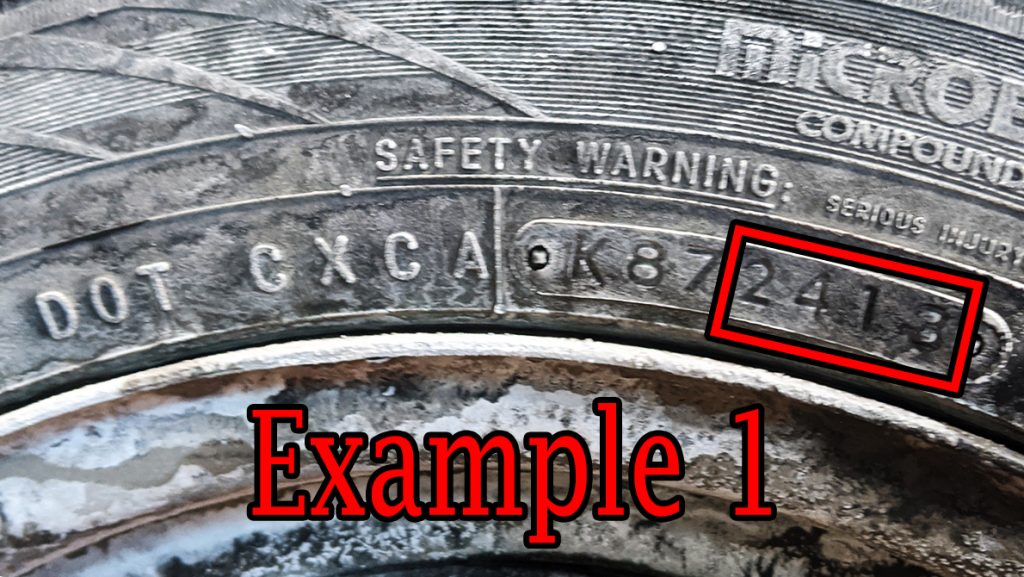


Those last 4 numbers – in the red box – are what you are looking for. They are a standardized date code set by the Department of Transportation in the U.S.A. – but is recognized worldwide, so you may find this date-code all over the world! The first two numbers signify the week and the second two numbers signify the year of manufacture.
- Example 1: The date code is a bit hard to read because of road salt on the tire, but it reads “2418” – so this tire was manufactured in the 24th week of 2018 and must be replaced before June, 2028.
- Example 2: The date code reads “3615” – so this tire was manufactured in the 36th week of 2015 and must be replaced before September, 2025.
- Example 3: The date code reads “2220” – so this tire was manufactured in the 22nd week of 2020 and must be replaced before mid-May, 2030.
In summary, then
To sum it up; your tires do have a useful life and if you are a low mileage driver – or like buying used cars – you may run into a situation where your tires have plenty of tread depth left but should not be used any more. Have your mechanic/technician of choice check your tires during your regular service, or check it for yourself by reading the numbers off your sidewalls. Either way, have your tires inspected at least once per year for abnormalities and you should be in for some happy motoring!
-Dan
Things you may find useful
The links below are affiliate links and items you purchase with them will cost you nothing extra but may provide a commission for this website and its creator/author – me.
Canadian Links:
Tread Depth Measuring Tool: https://amzn.to/3sk7IYX
Tread Depth Measuring Tool (but fancy): https://amzn.to/34xRi78
Tread Depth Measuring Tool (looks fancy but isn’t): https://amzn.to/3J3nC0E
Tire Pressure Gauge: https://amzn.to/3J6A8MN
Tire Pressure Gauge (but fancy): https://amzn.to/32ZOEGO
Emergency 12v Tire Inflator: https://amzn.to/34BUpL8
Tire Cleaning Supplies: https://amzn.to/3JnmJjR
American Links:
Tread Depth Measuring Tool: https://amzn.to/3ruan2Z
Tread Depth Measuring Tool (but fancy): https://amzn.to/3goLsrx
Tread Depth Measuring Tool (looks fancy but isn’t): https://amzn.to/34HzNS4
Tire Pressure Gauge: https://amzn.to/3GwQ5dE
Tire Pressure Gauge (but fancy): https://amzn.to/3rwaBXi
Emergency 12v Tire Inflator: https://amzn.to/3sjAqcD
Tire Cleaning Supplies: https://amzn.to/3LcSLRb

